
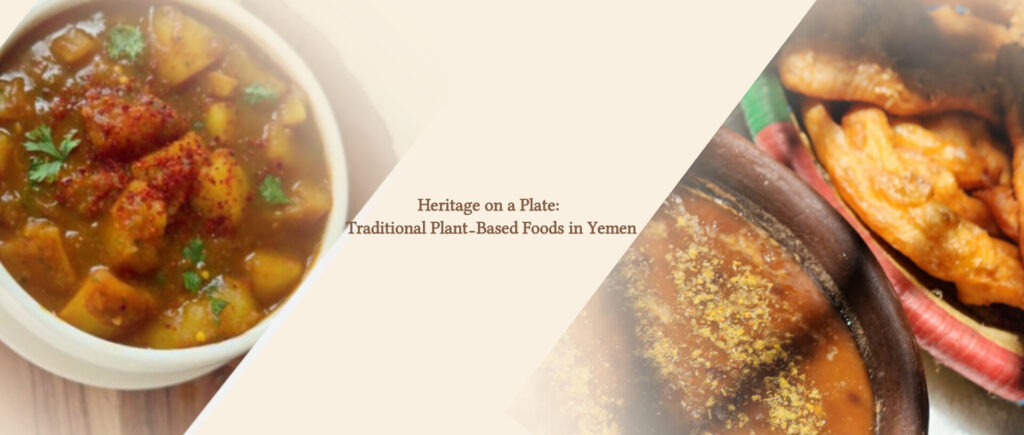
In the alleyways of Old Sana’a, you do not need a sign to point you towards Yemeni cuisine; the aroma alone is enough. From a steaming pot of bara‘i tucked into the corners of homes and markets, to golden discs of zalabiya prepared fresh in front of customers, the stories of a culinary heritage that has endured through the generations come to life. Here, traditional dishes are not served merely as everyday meals, but as a living memory passed down from one generation to the next, and as an expression of a Yemeni identity shaped by simple ingredients, rich flavours, and people’s deep connection to their land and heritage.
Contrary to what many may assume, Yemeni cuisine, across the country, is rich in dozens of traditional plant-based dishes that have long relied on grains, pulses and locally grown vegetables. These foods formed an integral part of the Yemeni diet long before plant-based eating became a global trend. They remain present today in homes and traditional markets, bearing witness to the resilience of Yemen’s culinary heritage and its ability to preserve its authenticity despite changing lifestyles.
In this report, we take you on a journey from the alleyways and markets of Old Sana’a to the coastal governorate of Aden, where traditional plant-based dishes continue to be prepared much as they were by previous generations. We explore their stories and ingredients, and examine their connection to cultural identity, revealing how these simple recipes have become a culinary legacy reflecting the diversity and richness of Yemen’s heritage.
Bura‘i
According to the study Food in Yemen during the Period 1847–1967 and the Influences Introduced to It: A Historical and Cultural Study, by Dr Amal Al-Humairi, Associate Professor in the Department of History and International Relations at Sana’a University, Bura‘i — pronounced with a short i sound after the “b” and a silent “r” — is a traditional dish closely associated with Sana’ani cuisine, which over time spread to popular markets in other governorates.
It is a Yemeni dish made from pulses and peas, which are soaked, boiled and then cooked with savoury spices and hatm, an ingredient that gives the dish its dark colour. Bura‘i may have been among the grains sold in the historic al-Lasasin market — known colloquially as al-lasis — which is mentioned in early historical sources and discussed in the book The Early Harvest as consisting of dujar and other grains boiled in hot water.
The dish is particularly popular in Sana’a, especially in Souq al-Milh, the city’s historic Salt Market. It is eaten either with a spoon or with kudam bread. According to several vendors, it is a filling meal because it provides different sources of energy while remaining inexpensive. Its close association with traditional markets has also helped establish it as one of Sana’a’s best-known popular dishes.
Batat bil-Humur: A Culinary Legacy from Aden
Al-Humairi explains in her study that batat bil-humur is a popular Adeni dish widely found in traditional markets. It consists of chopped potatoes, soaked tamarind — locally known as humur — Adeni chilli spices and other seasonings.
Many Adeni dishes reflect a blend of external influences, shaped by Aden’s long-standing role as a commercial and maritime hub and a coastal city exposed to diverse cultures. This exchange has influenced many aspects of life, including its food traditions, with Indian and other Asian spices and ingredients becoming incorporated into a range of popular local dishes.